
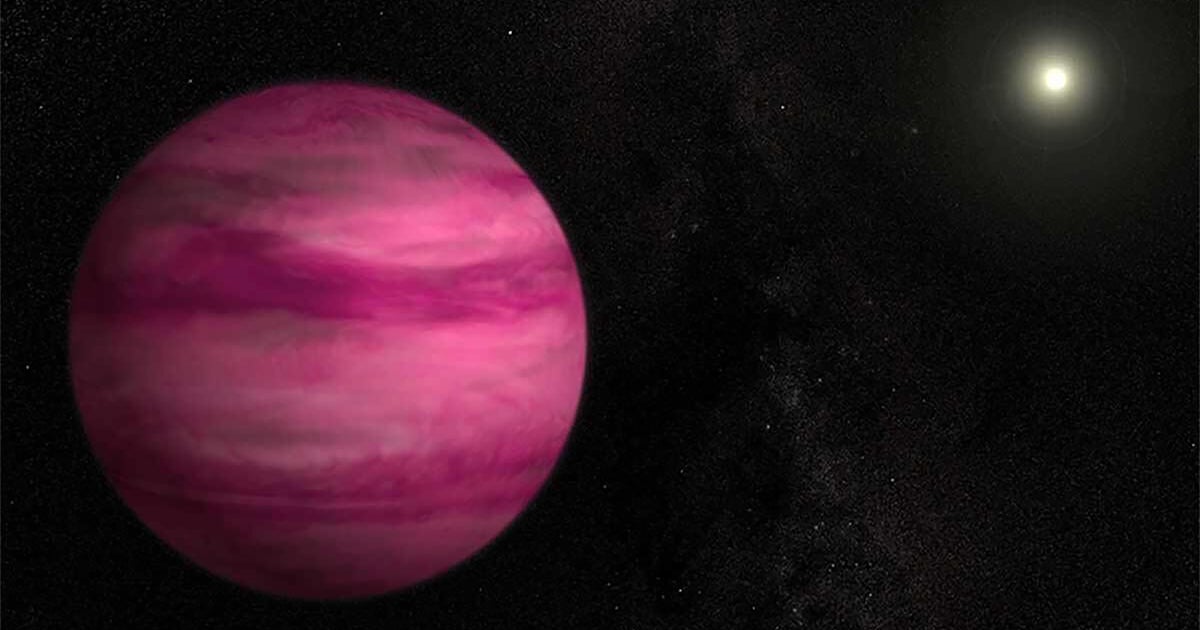
Introduction to the "Pink Planet"
The "Pink Planet," formally known as GJ504b, is a planetary-mass companion that has been a subject of interest for astronomers since its discovery in 2013. Located approximately 150 light-years from Earth, this celestial body is not technically a planet but rather a large object that orbits a star. Recent research using the Webb telescope has shed new light on the composition of the "Pink Planet," revealing the presence of salty clouds surrounding it. The Discovery of GJ504b GJ504b was first discovered in 2013 using the Subaru Telescope in Hawaii. Initially, it was thought to be a planet, but further research revealed that it was actually a planetary-mass companion, meaning it has a mass similar to that of a planet but does not orbit the Sun. The discovery of GJ504b was significant, as it provided insight into the formation and evolution of planetary systems.The Webb Telescope's Findings
The Webb telescope, launched in 2021, has been instrumental in studying the "Pink Planet" and its surroundings. According to recent research, the Webb telescope has detected salty clouds surrounding GJ504b. These clouds are composed of salt and other particles, which are thought to have originated from the planetary-mass companion's atmosphere. The discovery of salty clouds on the "Pink Planet" has significant implications for our understanding of the formation and evolution of celestial bodies.- The Webb telescope's discovery of salty clouds on the "Pink Planet" provides insight into the atmospheric composition of celestial bodies.
- The presence of salt and other particles in the clouds suggests that the "Pink Planet" has a complex and dynamic atmosphere.
- Further research is needed to fully understand the implications of the Webb telescope's findings and to determine the origins of the salty clouds surrounding GJ504b.
Conclusion
The discovery of salty clouds on the "Pink Planet" is a significant finding that has shed new light on the composition and atmosphere of this celestial body. The Webb telescope's findings have provided insight into the atmospheric composition of the "Pink Planet" and have implications for our understanding of the formation and evolution of celestial bodies. Further research is needed to fully understand the implications of the Webb telescope's findings and to determine the origins of the salty clouds surrounding GJ504b. As astronomers continue to study the "Pink Planet" and its surroundings, we can expect to learn more about this fascinating celestial body and its place in the universe.Stay tuned to Buzztoday24 for more updates.
Post a Comment